

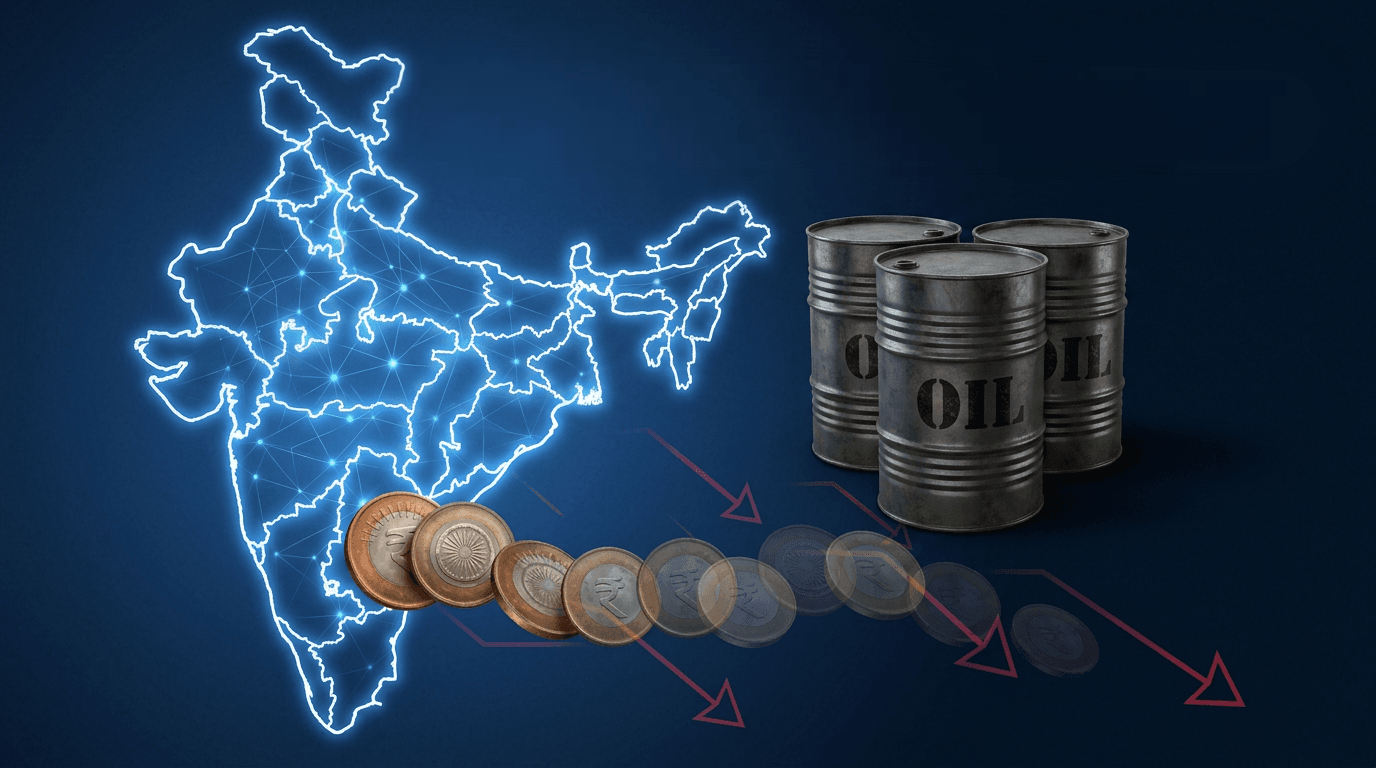
The headline number sounds distant at first glance, ₹75,000 crore, a budgeted dividend expectation from public sector undertakings that quietly supports the fiscal stability of India. But behind this number lies a fragile chain of dependencies that begins thousands of kilometres away in West Asia and travels through oil fields, shipping routes, currency markets, and corporate balance sheets before finally reaching the government’s books. When a prolonged war erupts in a region like Iran and its surrounding geopolitical sphere, the consequences are not confined to the battlefield. They seep into global commodity markets, disrupt supply chains, elevate uncertainty, and ultimately squeeze profitability for large state run enterprises that the government relies on for dividends. What appears to be a geopolitical crisis quickly transforms into a fiscal concern, and more importantly, an investment reality for individuals who may not even realize how deeply interconnected these systems are.
At its core, the relationship between war and government revenue is not emotional or political, it is mechanical and economic. The government of India earns a significant portion of non tax revenue through dividends paid by central public sector enterprises. These companies operate in critical sectors such as oil, gas, power, metals, and infrastructure, all of which are highly sensitive to global price movements and input costs. When global tensions rise, especially in energy rich regions, commodity prices tend to spike sharply. Oil prices move up due to fears of supply disruption, shipping costs increase due to risk premiums, and insurance costs for trade escalate. For a country like India that imports a large portion of its crude oil, this creates immediate pressure on domestic companies such as oil marketing firms, upstream producers, and energy distributors. Their cost structures become unstable, their margins compress, and the profits that would otherwise be distributed as dividends to the government begin to shrink.
How Rising Commodity Prices Quietly Erode PSU Profits
The most direct transmission channel of war related stress into PSU profitability is through commodity prices, particularly crude oil. When tensions escalate in West Asia, oil prices do not just rise modestly, they often surge in unpredictable bursts driven by speculation, supply fears, and geopolitical signalling. For Indian oil companies, this creates a dual challenge. On one side, the cost of importing crude rises significantly, increasing working capital requirements and tightening liquidity. On the other side, the ability to pass on these higher costs to consumers is often restricted due to political and inflationary considerations. Governments tend to intervene to keep fuel prices stable, especially in a country where fuel inflation has a cascading effect on transportation, food prices, and overall cost of living. This means that oil marketing companies are forced to absorb a part of the cost increase, directly impacting their profitability.
The situation becomes even more complex when you consider currency movements. War driven uncertainty typically strengthens the US dollar as investors seek safe assets, which in turn weakens emerging market currencies like the Indian rupee. A weaker rupee makes oil imports even more expensive, amplifying the cost pressure on PSUs. This combination of higher input costs and limited pricing power creates a squeeze that is difficult to escape. Profit margins contract, earnings visibility declines, and dividend paying capacity reduces. What the government had budgeted as a steady inflow of ₹75,000 crore begins to look increasingly optimistic under such conditions.
Why PSU Dividends Matter More Than You Think
It is easy to underestimate the importance of PSU dividends in the larger fiscal framework, but they play a critical role in bridging the gap between government spending and revenue. Dividends from state owned companies are a predictable and relatively stable source of income, especially when tax collections fluctuate due to economic cycles. When these dividends fall short, the government faces a difficult choice. It can either cut spending, which slows economic growth, increase borrowing, which raises interest costs, or look for alternative revenue sources, which may include higher taxes or asset sales. Each of these choices has consequences that eventually filter down to businesses and individuals.
For investors, the implications are layered. Many retail investors hold shares of public sector companies because of their historically attractive dividend yields. These stocks are often perceived as stable income generating assets. However, when profits decline due to global shocks, dividend payouts are among the first things to be adjusted. A reduction in dividends not only affects income but also signals underlying stress in the business, which can lead to stock price corrections. This dual impact of lower income and capital erosion can catch investors off guard, especially those who rely heavily on PSU stocks for steady returns.
The Ripple Effect Across Sectors and the Economy
The impact of a prolonged war does not remain confined to oil and energy companies. It spreads across sectors in a ripple effect that gradually weakens the broader economic environment. Higher fuel costs increase transportation expenses, which raise the cost of goods across industries. Manufacturing companies face higher input costs for raw materials such as metals and chemicals, many of which are linked to global commodity prices. Power generation companies deal with rising fuel costs, which can strain their financials if tariffs are regulated. Even banking sector PSUs are indirectly affected as stressed industries lead to higher credit risk and potential loan defaults.
This interconnected stress feeds back into the government’s fiscal position. Lower profitability across multiple PSUs means lower aggregate dividends. At the same time, the government may need to increase spending to manage inflation, provide subsidies, or support affected sectors. This creates a widening gap between income and expenditure, putting pressure on the fiscal deficit. A higher fiscal deficit can lead to increased borrowing, which may push up interest rates and crowd out private investment. For the average citizen, this translates into higher loan costs, slower job growth, and reduced economic momentum.
A Real World Scenario That Investors Often Miss
Consider a simplified scenario to understand how this chain reaction plays out in practice. A spike in oil prices due to war in West Asia leads to higher fuel costs in India. The government, concerned about inflation and public sentiment, limits fuel price increases. Oil marketing companies absorb part of the cost, reducing their profits. These companies then declare lower dividends, which reduces government revenue. To compensate, the government increases borrowing. Higher borrowing leads to higher bond yields, which in turn pushes up interest rates across the economy. Businesses face higher borrowing costs, slowing expansion. Consumers face higher loan EMIs, reducing discretionary spending. The stock market reacts to slower growth expectations, leading to volatility and highlighting the impact of recession on investments as global disruptions begin to affect returns across asset classes.
At the same time, inflation erodes purchasing power, forcing households to cut back on investments or shift towards safer assets. Investors who were relying on PSU dividends for income now face reduced payouts and potential capital losses. What started as a geopolitical conflict has now impacted household finances, investment returns, and economic growth in a very tangible way.
Why This Risk Is Structural, Not Temporary
One of the most important insights that investors must understand is that the risk from prolonged geopolitical conflict is not merely temporary noise. It exposes structural vulnerabilities in economies that are heavily dependent on imported energy and state owned enterprises for fiscal stability. India’s reliance on imported crude makes it particularly sensitive to global price shocks. At the same time, the government’s dependence on PSU dividends creates a feedback loop where corporate profitability directly influences fiscal health.
This structural linkage means that even if the war does not directly involve India, its economic consequences can still be significant and long lasting. Markets may initially react sharply and then stabilize, but the underlying impact on earnings, fiscal balance, and investment sentiment can persist for several quarters. Investors who ignore this connection risk misjudging both short term volatility and long term trends.
What This Means for Your Investment Strategy
For individual investors, the key takeaway is not to panic but to understand the deeper dynamics at play. PSU stocks should not be viewed as guaranteed income generators, especially in a globally interconnected economy where external shocks can quickly alter profitability. Diversification becomes critical, not just across sectors but also across asset classes. Exposure to sectors that benefit from higher commodity prices, such as upstream oil producers or certain export oriented industries, can provide a natural hedge against rising input costs.
At the same time, it is important to pay attention to macroeconomic indicators such as crude oil prices, currency movements, and fiscal deficit trends. These indicators provide early signals of stress that can impact both corporate earnings and government finances. Investors should also evaluate the quality of PSU businesses, focusing on those with stronger balance sheets, better pricing power, and lower regulatory constraints. Blindly chasing high dividend yields without understanding the underlying risks can lead to disappointing outcomes.
Conclusion
The story of ₹75,000 crore at risk is not just about a number in the government’s budget, it is a reflection of how deeply interconnected global events and domestic finances have become. A prolonged war in West Asia has the potential to disrupt commodity markets, compress PSU profits, and weaken government revenue in ways that are not immediately visible but profoundly impactful. For investors, this is a reminder that markets do not operate in isolation. Geopolitics, economics, and corporate performance are part of the same ecosystem, and understanding their interplay is essential for making informed decisions.
As you navigate your investment journey, the goal should not be to predict every geopolitical event but to build a portfolio that can withstand uncertainty. Recognize the risks, diversify intelligently, and focus on long term resilience rather than short term income assumptions. Because in a world where a conflict thousands of kilometres away can influence your returns, awareness is not just an advantage, it is a necessity.
FAQ Section
War in West Asia impacts global oil and commodity prices. Since many Indian PSUs operate in energy and related sectors, rising costs reduce their profits, leading to lower dividends paid to the government.
PSU dividends are a share of profits that government owned companies pay to the government. They are a key source of non tax revenue and help manage the fiscal deficit.
Higher oil prices increase input costs for companies, especially in transportation, manufacturing, and energy sectors. This reduces profitability and can impact stock prices and dividends.
Not necessarily, but investors should be cautious. It is important to evaluate company fundamentals, diversification, and exposure to global risks rather than relying only on dividend yields.
Investors can diversify across sectors and asset classes, monitor macroeconomic indicators, and include defensive investments that perform better during periods of uncertainty.
Yes, a higher fiscal deficit can lead to higher interest rates, inflation, and reduced government spending, all of which impact economic growth and personal finances.