

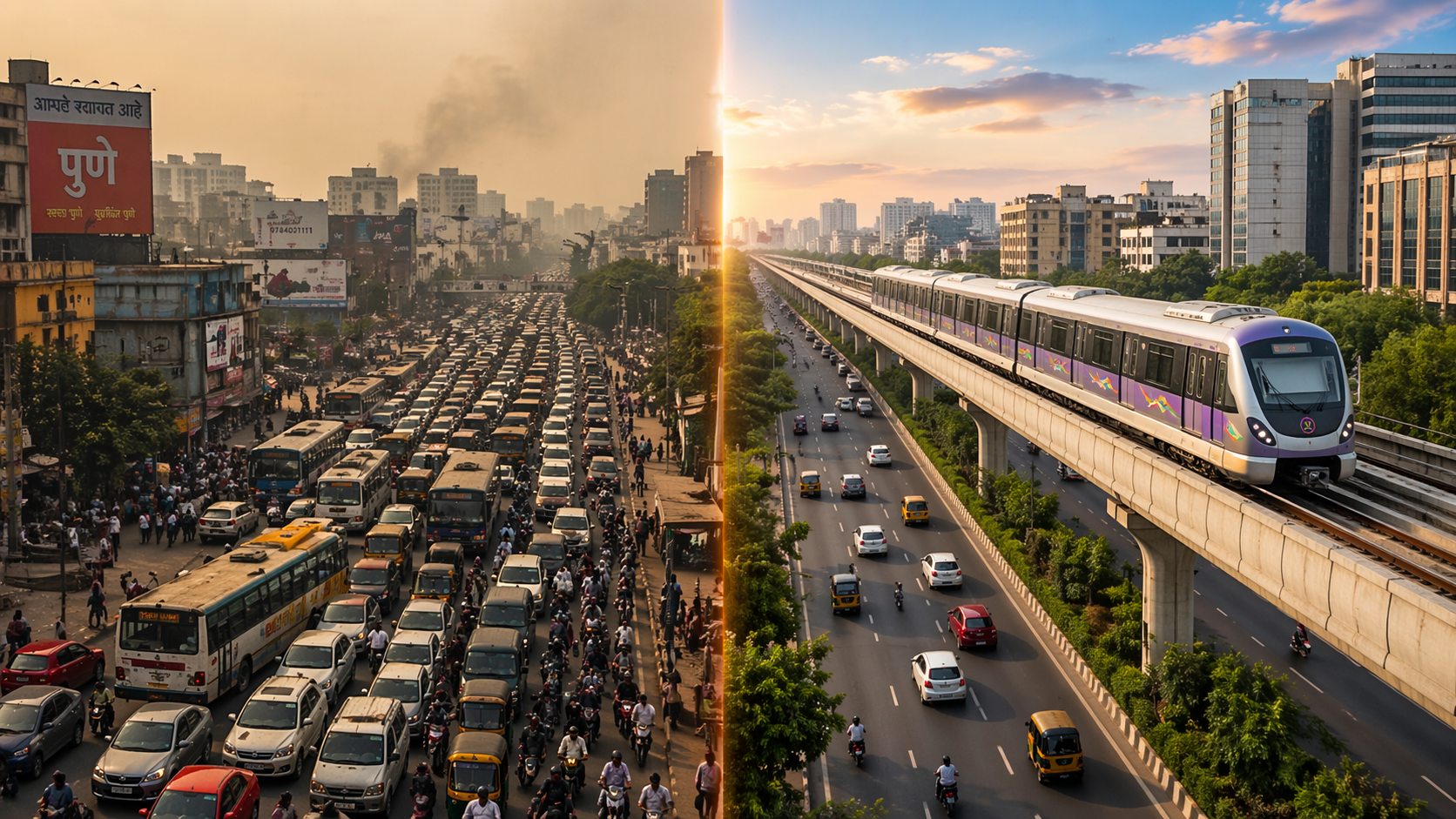
Pune Metro Benefits: Did It Really Solve Pune’s Traffic Problem?
For anyone who has lived in Pune for 20 or 30 years, traffic is no longer just an inconvenience it has become part of daily life. Whether it is JM Road, Swargate, Shivajinagar, Baner Road, or Nagar Road, the same story repeats every day: long signals, crowded roads, and wasted hours.
This is where people started asking about Pune Metro Benefits. Would the metro finally reduce traffic? Would it save time? Would it improve property values near stations? Most importantly did Pune Metro actually solve Pune’s traffic problem?
The answer is not a simple yes or no.
Pune Metro has improved mobility in many parts of the city, but traffic congestion is a larger issue involving road planning, public transport habits, and population growth. If you are a daily newspaper reader or someone who has watched Pune grow over three decades, this article will help you understand what has changed and what still needs work.
Why Pune Needed Metro So Urgently
Pune was once known as a peaceful city with manageable roads and short travel times. That changed rapidly after IT expansion, industrial growth, and population migration from nearby cities.
According to urban transport estimates, Pune has over 40 lakh registered vehicles (RTO Data). This is one of the highest vehicle densities among Indian cities. Two-wheelers dominate the roads, followed by cars and commercial transport.
Road widening alone could not solve the issue. Flyovers helped in some areas, but they shifted congestion rather than removing it. PMPML buses remained useful but often struggled with delays and overcrowding.
This created the need for mass rapid transit.
Metro systems work best when thousands of people shift from private vehicles to shared transport. Cities like Delhi and Bengaluru have shown this pattern clearly. Pune needed the same structural shift.
For example, a person travelling from Vanaz to Civil Court during peak hours by car could spend 50–70 minutes depending on traffic. Metro reduces that significantly and offers predictable timing.
That reliability is often more valuable than speed.
Pune Metro Benefits for Daily Commuters
The most visible Pune Metro Benefits are time savings, travel comfort, and reduced dependency on personal vehicles.
Faster and Predictable Commute
Unlike road traffic, metro timing remains consistent. A 30-minute metro journey usually remains 30 minutes, while road travel can become 60 minutes during rain or peak office hours. For office workers, students, and senior citizens, this predictability matters.
Lower Stress and Better Travel Experience
Driving daily in Pune traffic is physically and mentally exhausting. Parking is another problem in commercial areas like FC Road, Shivajinagar, and Kothrud. Metro removes both concerns.
For example, My friend Rajesh, age 48, works near Shivajinagar and lives in Anand Nagar. Earlier, he drove daily and spent nearly ₹7,000 monthly on fuel and parking. After shifting partially to metro, his monthly travel cost dropped to around ₹3,500.
That is nearly ₹42,000 annual savings Considering Maintenance of vehicle and fuel surcharge.
Safer Alternative During Monsoons
Pune roads during monsoon create delays, waterlogging, and accident risks. Metro provides a safer and more reliable option during such months. This matters especially for families with school-going children and elderly parents.
Did Pune Metro Solve Pune Traffic Problem?
This is the main question and the honest answer is: partially.
Metro reduced pressure in connected corridors, but it has not solved Pune’s traffic problem completely.
Where It Helped
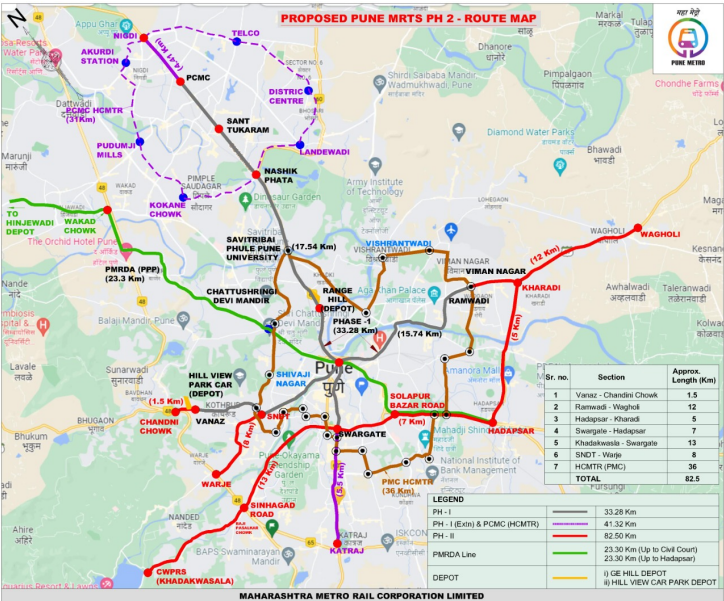
Routes like PCMC to Civil Court and Vanaz to Ramwadi have improved travel options significantly. Areas around metro stations now see better public movement and less dependence on personal transport. Peak-hour pressure has reduced in selected corridors.
Where It Still Falls Short
Large parts of Pune still depend entirely on roads. Hinjewadi, Wagholi, Undri, Kharadi, and several fast-growing areas need stronger metro connectivity. Last-mile connectivity is also a major issue. If someone exits the metro station but still needs an auto for 3 km, many people choose to drive the entire route instead. This limits adoption.
Comparison Table: Before vs After Metro
| Factor | Before Metro | After Metro |
|---|---|---|
| Commute predictability | Low | High |
| Fuel dependence | High | Reduced |
| Parking stress | High | Low |
| Travel during monsoon | Difficult | Better |
| Full-city traffic reduction | Limited | Partial |
So yes, Pune Metro Benefits are real but metro alone cannot fix traffic without feeder buses, parking policy reforms, and better urban planning.
Pune Metro and Real Estate Growth
In real estate, connectivity directly affects value. Properties near metro stations often see stronger demand because buyers and tenants prioritize daily convenience.
Metro Influence on Residential Demand
Areas near stations such as Nal Stop, Civil Court, Shivajinagar, and PCMC have shown stronger buyer interest.
For example, if a 2 BHK apartment near a metro station rents for ₹30,000 per month while a similar apartment farther away gets ₹25,000, the metro accessibility creates a measurable return. That matters for both investors and homeowners.
Commercial Property Advantage
Retail spaces near metro exits also gain footfall. Small businesses, clinics, and office spaces benefit from steady commuter movement. This creates stronger long-term commercial value.
For investors, metro proximity should be one factor not the only factor. Builder quality, legal approvals, water supply, and future infrastructure matter equally.
Cost Savings and Time Savings for Families
People often focus only on ticket price, but the bigger savings come from fuel, vehicle maintenance, and time.
A Simple Family Example
Consider Meena and Suresh, both working professionals in their early 50s.
- Monthly fuel expense: ₹9,000
- Car maintenance average: ₹3,000/month equivalent
- Parking and small costs: ₹2,000
Total transport burden: nearly ₹14,000 monthly.
If one major commute shifts to metro, even a 40% reduction saves about ₹5,500 monthly.
That becomes ₹66,000 annually.
This is not small it can fund SIP investments, school fees, or emergency savings.
Time Has Financial Value Too
Saving 45 minutes daily means over 20 hours per month.
That is time for family, health, or additional work.
People rarely calculate this, but it is one of the strongest Pune Metro Benefits.
Challenges Pune Metro Still Faces
Metro success depends on usage, not just construction.
Last-Mile Connectivity
This is the biggest issue today. Stations must connect smoothly with autos, buses, shared mobility, and walkable roads.
Without that, metro remains incomplete.
Public Habit Change
Many residents still prefer personal vehicles, especially two-wheelers. Habit change takes time.
Delhi Metro succeeded because people trusted frequency and convenience. Pune needs the same long-term behavioral shift.
Integration with Other Transport
Metro must work with PMPML, not separately.
Unified ticketing, feeder buses, and better station planning will decide future success.
Making Pune Metro Work Better for Pune
The discussion around Pune Metro Benefits should not be limited to “metro is good” or “traffic is still bad.” The reality sits in between.
Metro has improved commuting, reduced fuel dependence, supported better real estate value, and created a more reliable transport option for thousands of people. It has especially helped in connected corridors where road congestion was severe.
But Pune’s traffic problem is larger than one transport system.
Your next steps:
- Check whether your daily route can shift partially to metro
- Compare your monthly fuel and parking costs against metro travel
- If buying property, evaluate metro connectivity carefully
- Follow upcoming expansion plans before making long-term real estate decisions
The best transport solution is not always owning a bigger car it is choosing smarter daily movement.
Pune Metro Benefits are strongest when metro becomes part of a wider city planning strategy. As more routes open and connectivity improves, Pune can move closer to solving its traffic challenge.
Disclaimer: This article is for educational purposes. Consult a certified financial planner or local real estate expert for personalized advice before making investment or property decisions.
FAQ SECTION
No, Pune Metro has only partially solved the traffic problem. It improved major corridors and reduced dependence on private vehicles in connected areas, but last-mile connectivity and incomplete coverage still limit full impact.
The main benefits are faster travel, predictable commute time, lower fuel expenses, less parking stress, and safer travel during monsoon seasons.
In many cases, yes. Homes near metro stations often attract better rental demand and stronger resale interest because buyers value convenience and faster city access.
Usually yes. When you include fuel, parking, and maintenance, metro travel is often significantly cheaper than driving daily, especially for office commuters.
Areas like PCMC, Civil Court, Shivajinagar, Vanaz, Nal Stop, and connected corridors currently benefit the most from operational metro routes.
Yes, but only if combined with legal verification, builder reputation, and infrastructure planning. Metro access should support your decision, not become the only reason to invest.
Metro offers faster and more predictable travel, while PMPML offers wider route coverage. The best system is when both work together through strong integration.





2 Responses
Your insight brings attention to a detail that truly matters.
Great article, very helpful!